NSBproject assesses technology, industrialisation, integration, market potential, team capabilities, and legal and regulatory considerations, identifying bottlenecks and defining a clear development roadmap.
Europe produces more tech startups than the United States, but has far less capital to bring them to market. According to the European Commission, an average of 15,200 startups were founded per year in Europe between 2018 and 2023, versus 13,700 in the US — yet in 2024, available EU venture capital was 80–84% lower than in the US across growth stages. The European Investment Fund also found that only 14% of fund managers see European risk appetite as strong at pre-seed and Series A, compared to 66% in the US. In Italy, Bank of Italy data show venture capital investment averaged just 0.03% of GDP in 2021–2023 — a third of France’s and Germany’s share, and only a fifth of their investment value.
The issue isn’t just the amount of capital available. Investors need clarity on which risks a project has already addressed, which remain open, and how much capital is needed to close the gaps. Good technology alone isn’t enough: a project can have an advanced prototype and strong scientific results, yet still be far from market-ready due to a missing business model, gaps in skills, an undefined regulatory strategy, or no clear path to customers.
To measure this gap, NSBproject developed a dedicated methodology for innovation projects, university spin-offs, and deep-tech startups, tested over more than two years across 30+ technologies, digital health/health-tech ventures, and EU-funded project outcomes. It works like a multidimensional check-up, assessing not just how developed the technology is, but how ready the entire solution is to be industrialized, integrated, regulated, funded, and adopted by the market. The methodology is currently undergoing scientific validation with Flanders Make, one of Europe’s leading tech-transfer hubs (5+ universities, 2,000+ member companies).
Six readiness dimensions
The assessment measures six independent indicators:
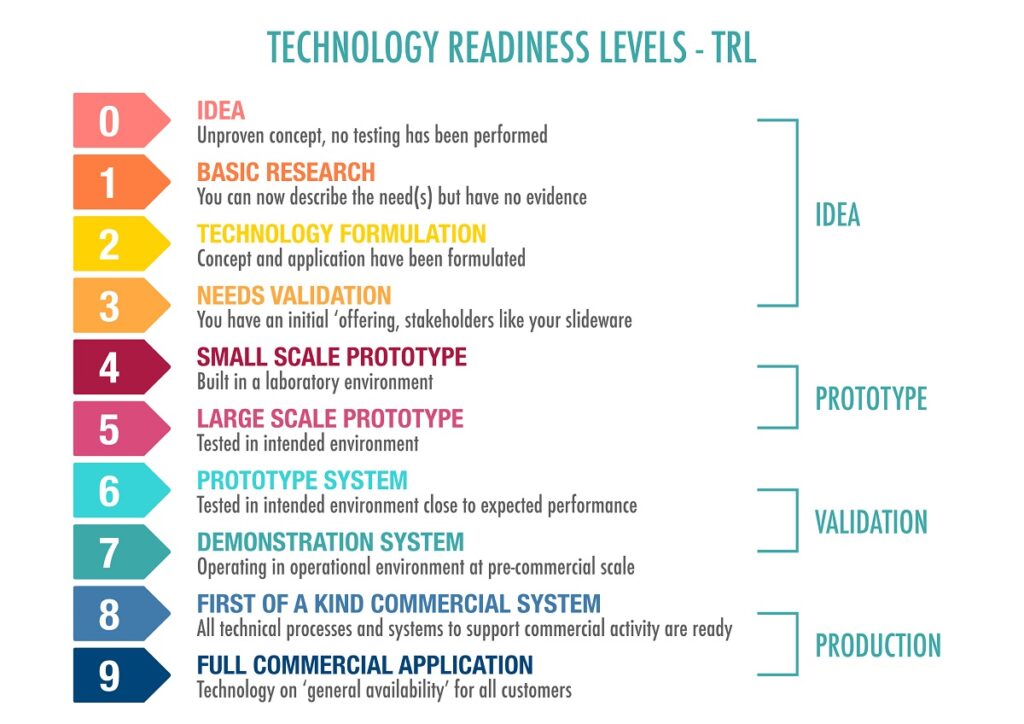
- Technology Readiness Level – technology maturity
- Manufacturing Readiness Level – production/industrialization capacity
- Integration Readiness Level – internal and external system integration
- Commercial Readiness Level – market, business model, customers, value chain
- Team Readiness Level – skills, roles, organizational capacity
- Legal Readiness Level – IP, privacy, contracts, compliance, regulation
These combine into an overall Solution Readiness score, weighted by NSBProject’s 20+ technology-transfer consultants to prevent strong technical maturity from masking serious commercial, organizational, or regulatory gaps.
A common mistake, the report notes, is assuming a technology is “ready” just because the prototype works — when in reality many research-born projects stall not for scientific reasons, but because the customer, business model, regulatory path, data ownership, or market-entry skills haven’t been defined yet. The European Commission’s 2026 consultation on reforming venture and growth-capital funds flagged similar barriers: complex early-stage due diligence and investor aversion to sectors — including biotech and health tech — seen as regulatory- or cycle-risky. As founder Andrea Jester puts it, investors don’t avoid risk itself — they avoid risk they can’t understand, compare, or manage.
Beyond a score
The check-up doesn’t just assign a number. For each dimension, it maps what’s been achieved, remaining gaps, adoption risks, the most urgent actions, the optimal sequencing of activities, and which partners or skills to bring in. It also factors in external conditions — market demand maturity, capital access, value-chain structure, integration capacity, and existing procurement channels. The output can, for instance, flag the need to validate demand before pitching investors, or to clarify IP ownership before an industrial partnership. Free or tailored assessments are available to startups, university spin-offs, and new tech ventures via NSBProject.
Digital health in focus
Digital healthcare is one of the areas where this multidimensional approach matters most, since reaching market requires combining technical development, clinical evidence, data governance, interoperability, regulatory approval, hospital access, economic sustainability, and industrial partnerships. NSBProject’s roadmaps connect identified gaps to the right partners — living labs for real-world validation, testing/certification bodies, European Digital Innovation Hubs, clusters, hospitals, OEMs, investors, and European networks. Sequencing decisions correctly (e.g., not approaching investors before validating demand, or not starting certification before the product is stable) is critical to avoiding wasted cost and time.
Case study: when the technology outpaces the business
One application involved a Greek university spin-off developing AI for analyzing capsule-endoscopy images. The assessment confirmed a strong technical and clinical core — notably, a meaningful reduction in false positives per exam compared to CNN-based approaches, which could help reduce “alert fatigue” among clinicians. But it also revealed a mismatch: strong integration capacity paired with low commercial maturity and an unformalized legal/regulatory path. Key blockers identified included: defining the business model and value chain, validating demand with hospitals and industry partners, navigating the MDR pathway for software as a medical device, clarifying dataset ownership, and strengthening the team’s commercial and regulatory skills.
Following the assessment, NSBproject worked with the company’s management to identify the four most promising market niches, running a deeper analysis of access strategies alongside dedicated pilots and business plans, giving management and investors a clearer basis for decision-making.
Sources: European Commission, EU Startup and Scaleup Strategy (2025); European Investment Fund, EIF Equity Survey 2025; Bank of Italy, Italian Venture Capital Market Report (2025); European Commission, Public Consultation on EU Venture and Growth Capital Funds Reform (2026).